When I first read that I was to research Elizabeth Blackadder I was quite excited because I went to a retrospective exhibition of hers at the Scottish National Gallery in September 2011. “Great”, I thought, “I’ll dig out my notes from then”. Unfortunately, these were of no help whatsoever, as I’ve waxed lyrical about all of her work, except for her still lives. I recall that at the time I really enjoyed the exhibition, however I didn’t really understand her still lives. I bought several postcards, including a still life; one of “Chinese Still Life with Arum Lilies”, painted in 1982. I’ve written in my learning log at the time “I’ve included this because I dislike it, and moreover, don’t understand it; therefore this is an attempt to discover why she has chosen to paint it in this way. My thoughts are that it appears to be a random collection of objects, painted in a way that gives them the appearance of being flat and without form. There doesn’t appear to be any attempt at constructing a composition, and your eye wanders around the painting, not knowing where to go next. The diagonal lines at the bottom right side are distracting and serve no apparent purpose. The viewer appears to be looking down onto a table top; however the objects appear to be side on.”
In an effort to understand it I’ve recorded the following, taken from http://www.exploreart.com; “Her flowers and still life have broken from the traditional organisation of space to create a carefully composed arrangement of the objects against a flattened background, which is brought parallel to the picture plane. In this way the eye is allowed to concentrate upon the quality of the painting and the details without distraction from three dimensional backgrounds. The arrangement of the flowers or objects plays a major part in the compositions, and there is always a visual excitement when her three- dimensional objects meet her two dimensional space.”
1980s she visited Japan on a number of occasions and many of her paintings at the time showed the influence of these trips. First visiting in 1985 and returning the following year, Blackadder’s interest in Eastern techniques and subject matter was realised in a series of vibrant oils and watercolours shown at the Mercury Gallery in 1991. Her desire to avoid the technical vibrancy of Tokyo took Blackadder to the Zen gardens of Kyoto; in many ways, her work depicts the principles of Zen which give paramount importance to the idea of empty space. Blackadder also traveled to the United States of America. Souvenirs of her travels would appear in many of her paintings.
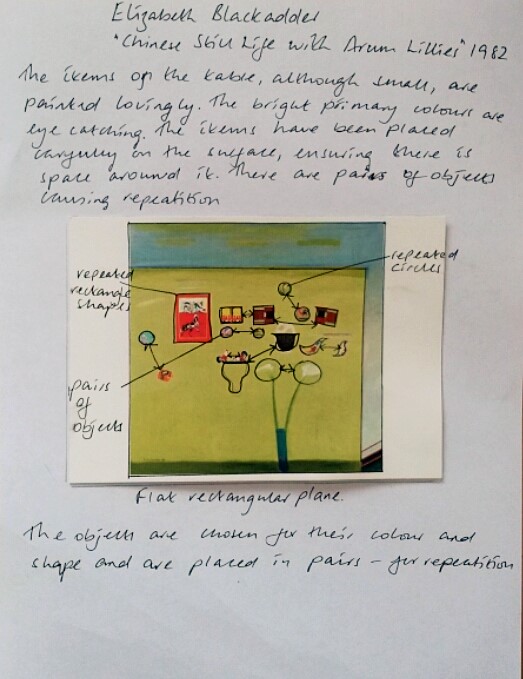
So, in the spirit of looking at this painting again, with a fresh pair of eyes and a little information on what Elizabeth Blackadder’s interests and influences were at that time, here goes; I now see an innovative approach to a traditional subject. Special care and attention have been taken in choosing which objects to paint, which colours to choose and where to place them. Instead of the traditional grouping of three objects together, there are pairs; two lilies, two boxes, two pairs of circular objects, two little chickens and other objects not the same, but placed together due to a similarity in shape, e.g. the bird and the coloured wrapped sweet. These objects are lovingly depicted and are possible cherished souvenirs of her travels abroad. We know she travelled to Japan at this time, and she may have been influenced by Zen gardens, where the focus is on open spaces. The items are lined up, almost as if on parade, but because they are small in size, they don’t dominate the composition, but instead become part of the table top, almost like part of a design on a patterned cloth.
I’ve found through looking at this painting again, I have a better understanding of Elizabeth Blackadder’s composition in still life.
 My drawing2 blog