I was already familiar with John Bellany’s work as I went to an exhibition at the National Gallery Scotland in 2012. I have the catalogue from it; ‘John Bellany, Keith Hartley with Alexander Moffat, John McEwen & Paul Bellany. I was quite excited about the workshop as it is an opportunity to see the art work close up. The Glasgow Museums Resource Centre stores over 4 million items from the Glasgow Art Galleries and Museums.
The first painting we looked at was The Fishers. This is a huge painting and it was fantastic being able to view it at close quarters. It was painted in 1966, in a figurative style, which went against the current trend of painting in an abstract style. ‘When the fashion in art was for abstraction, and figurative art was presumed to have been swept away forever by the tide, not just of fashion, but of history, he stood up and painted monumental figurative pictures’ (Keith Hartley with Alexander Moffat, John McEwen & Paul Bellany, 2012:7). In contrast, his peers were looking at Abstract Expressionism, and the work of action painters such as Jackson Pollock and Willem de Kooning, and colour field painters such as Mark Rothko. ‘Significantly Bellany’s earliest artistic efforts were of his immediate environment – the fishing boats at Port Seton, his ancestors, Scotland, and beyond.’ (Hartley with Moffat, McEwen & Bellany, 2012:9). He was painting what he saw every day; in other words he was being a Recorder. As well as recording scenes familiar to him as the son of a fisherman, he used symbolism in his work. ‘Boats as symbols of voyaging, of doom and tranquillity, as stages, as arks of sirens and omens, as bearers of cargoes of memory.’ (Hartley with Moffat, McEwen & Bellany, 2012:25. The colours in the painting were very vivid with lots of blood-red and the fish guts in the foreground repulse the viewer. The three figures, again a common theme, although looking at the viewer, do not engage with them, and almost seem to be challenging them.
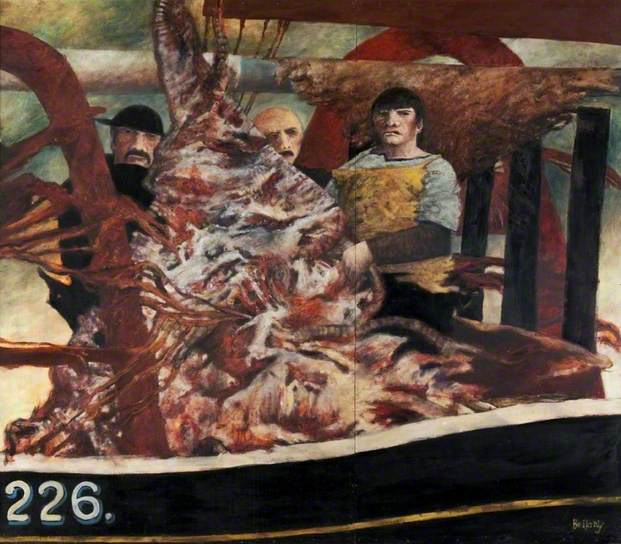
Bridgeman; (c) Glasgow Museums; Supplied by The Public Catalogue Foundation
- Date painted: 1966
- Oil on hardboard, 183.2 x 213.4 cm
- Collection: Glasgow Museums

Bridgeman; (c) Glasgow Museums; Supplied by The Public Catalogue Foundation
- Date painted: 1990
- Oil on canvas, 214 x 203.2 cm
- Collection: Glasgow Museums
The next one we looked at was Scottish Gothic. The name is reminiscent of American Gothic, but there the resemblance ends as there are three figures in John Bellany’s painting and only two in Grant Wood’s. Here we can see the use of symbolism, where the central figure has a bird perched on his head. ‘Another thing Beckmann was to teach Bellany was the use of symbolic attributes – people carrying fish, wearing masks, standing on stages. As the years went by Bellany learnt to use symbols as a complex language, sending silent messages between the dramatis personae of his pictures’. (Hartley with Moffat, McEwen & Bellany, 2012:13).
Next we looked at Dungness. The figures in his paintings are generic and not modelled on anyone. Although looking straight ahead, they do not engage with the viewer. This painting was made following a visit to Germany where amongst other things, he saw the Concentration Camps, but also saw the Isenheim Alterpiece painted by Matthias Grunewald.
Next we saw Journey to the End of the Night; a triptych. This is the title of a novel by Louis-Ferdinand Celine published in 1932, however there is no obvious connection to this. It is a triptych (possibly inspired by the Isenheim Alterpiece). It is an image depicting sexuality, but there is no joy in it. The figures in the back ground appear to be nun-like figures. The lobster represents female sexuality and the women appears to be dressed in the striped clothing from the Concentration Camps. ‘The second event to have a major impact on Bellany was his trip to East Germany in 1967….where he was emotionally and physically overwhelmed by a visit to the Buchenwald concentration camp’ (Hartley with Moffat, McEwen & Bellany, 2012:13).
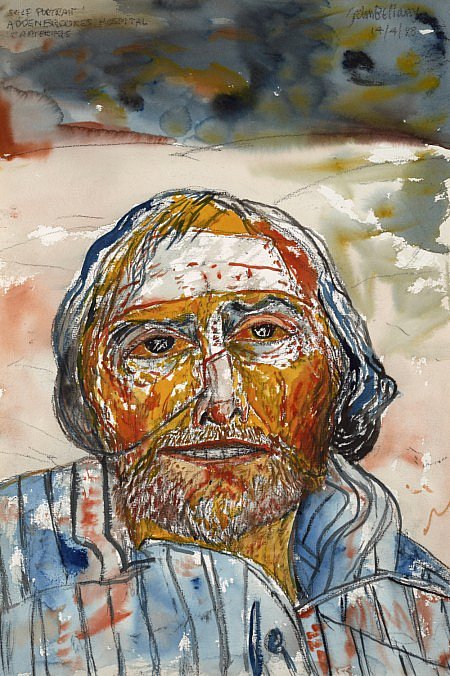
The next drawings were from the Addenbrooke’s Hospital period around 1988, when Bellany had a liver transplant which saved his life. ‘In 1988 it became plain that Bellany’s liver was deteriorating so fast that he did not have much longer to live unless he had a transplant. Against all the odds he was able to undergo the operation at Addenbrooke’s Hospital…..It was successful. As soon as Bellany came round from the anaesthetic he could not believe he was still alive. He asked for a pencil and paper and only after he was able to draw was he certain that he was alive. Over the next few weeks as he grew stronger he drew the doctors and nurses looking after him, but above all he drew himself, a new Lazarus.’ (Hartley with Moffat, McEwen & Bellany, 2012:77). He used pencil, red and black chalk and watercolour. These are very honest, direct drawings and I found them quite moving. The emotion he was feeling, the joy of being alive, comes through. The eyes in particular, are captivating. He exaggerates the almond shape and adds a lot of detail, and he really engages with the viewer, unlike in his previous paintings where the figures stare with hostility.
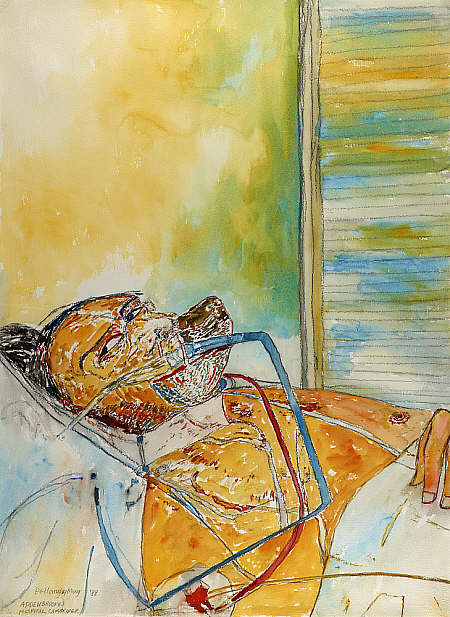
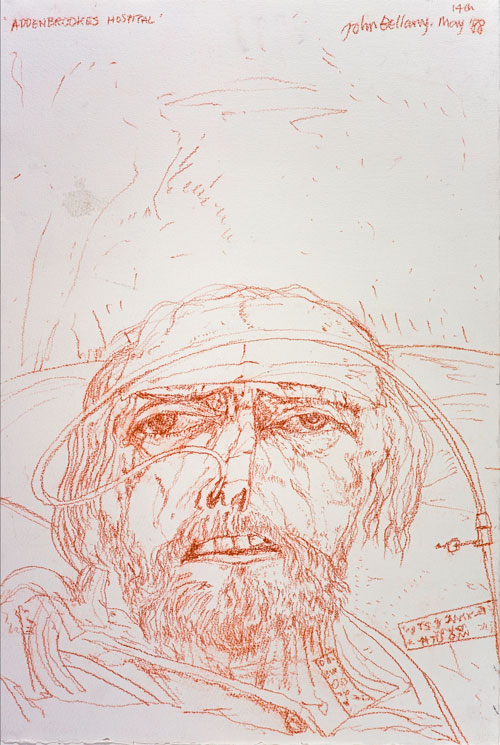
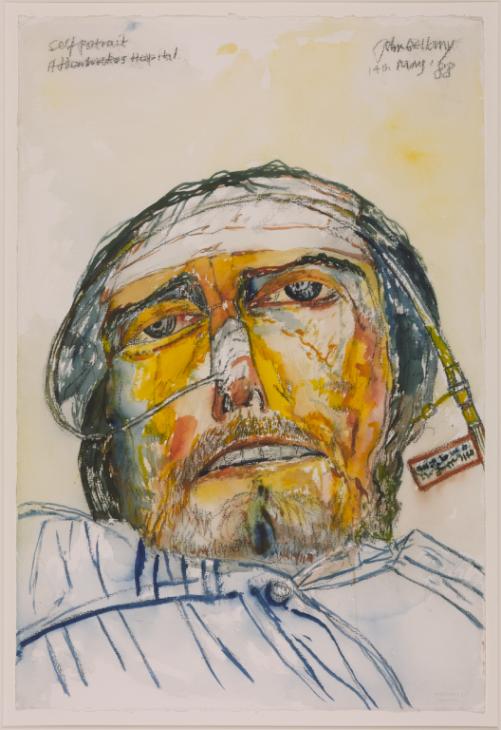
Self-Portrait 1988 John Bellany 1942-2013 Purchased 1990 http://www.tate.org.uk/art/work/T05735
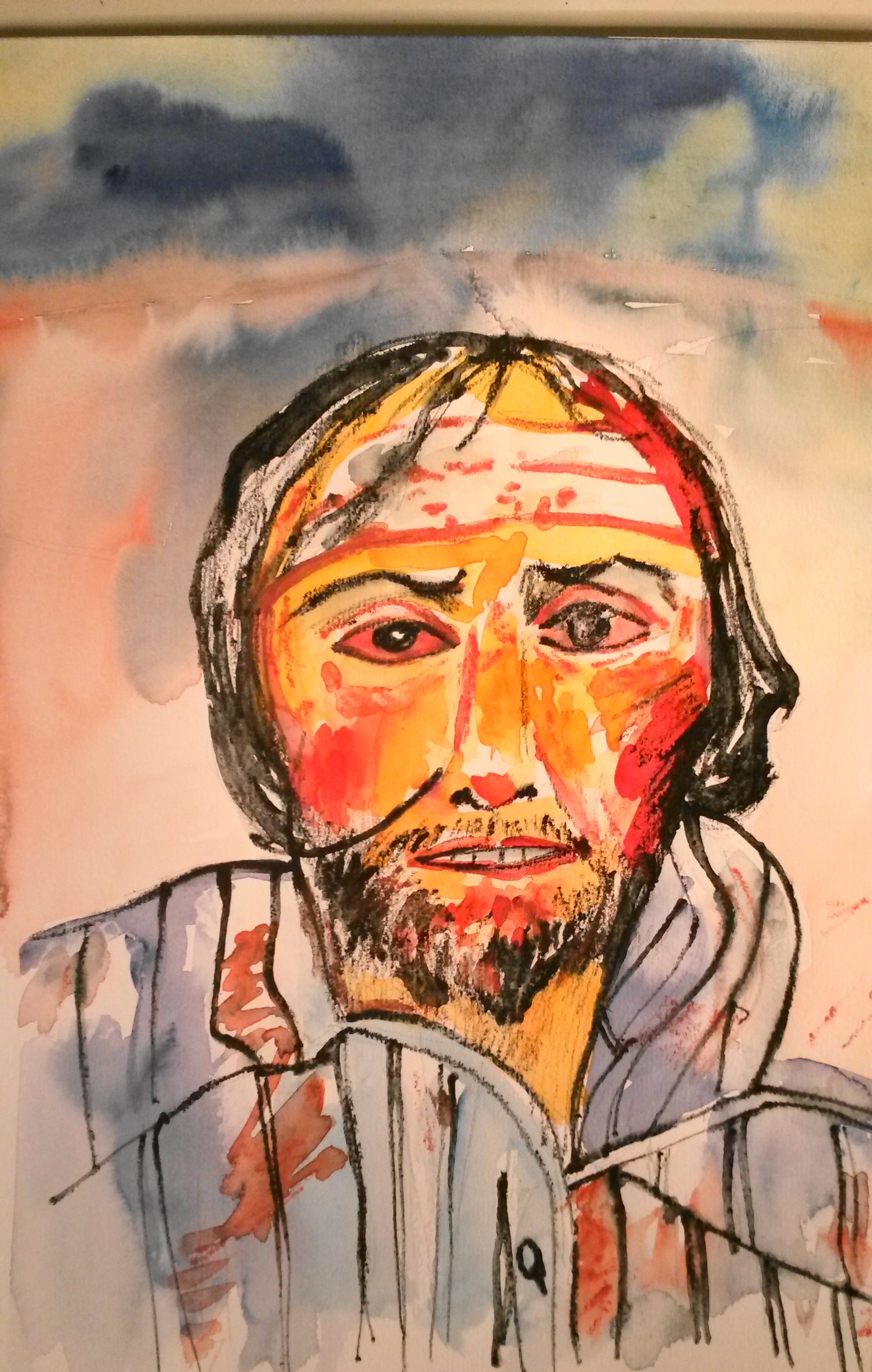
I decided to make a quick study of this self-portrait, in an attempt to discover how he made it. I drew mine with pencil first, then did a wet into wet wash with Cadmium Red and Indigo watercolour paint. I used watercolour paint wet on dry on the face, and striped pyjamas, then defined it using watercolour pencils, wetting the lead before drawing with it. The pyjamas are reminiscent of the striped clothing he saw at the Buchenwald Concentration Camp, and I’m quite sure the red splashes of blood are for artistic license.
User comments
Next we were shown some drawings which had never been on display to the public. There were beautiful delicate etchings, mono prints and prints which looked as though they may have been intended to be bound into a book, as there was poetry and text included.
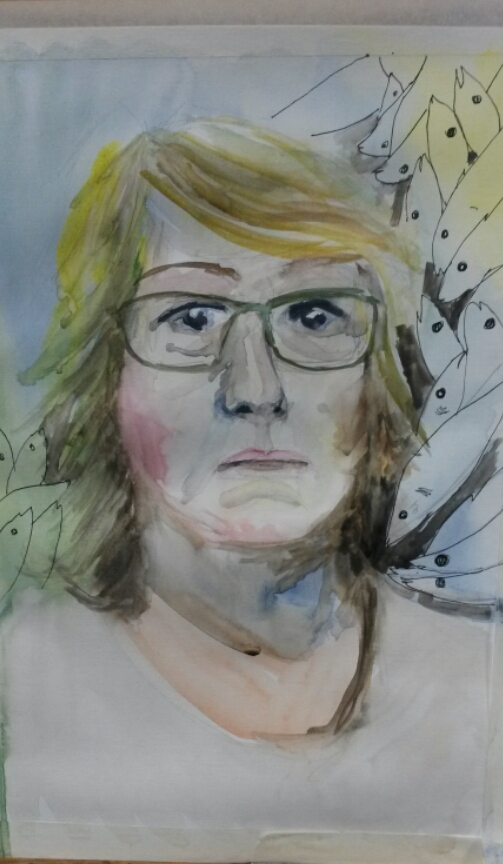
Next we were taken to the “Pickled ” room in the Resource Centre, where we had ten minutes to sketch one of the many jars containing all sorts of fish and other aquatic creatures. I draw a jar of Chlorophthalmus Agassizi, which looked a little like sardines to me and I was attracted by the way they were all cramped together like sardines. It made me think of Stress, like having too many thoughts crammed into your head at the one time.
Finally we were taken to a classroom where we did our own self-portrait and included our picked object in homage to John Bellany. I managed a self-portrait alright, but it bore no relation to the colour and expressiveness of Bellany’s. I became so focussed on trying to get something down, all thoughts of Bellany’s work went out of the window. Only later did it occur to me that we were encouraged to use easels; something I normally would never do when painting in watercolours. The expression and depth of emotion in his work has given me the idea to try to use this influence in the Emotion exercise.
 My drawing2 blog