Part One
Take a walk in a place you know well and make five different small drawn interactions in the environment using only what you find around you and your own body and without damaging any plants or animals in the process. Try to do things which will affect the way a visitor to the space would perceive it, either by directing their gaze or by changing the qualities of the place.
When I first read this brief, I immediately thought about using the beautiful Autumn leaves that were all around. Unfortunately, the weather has taken a turn for the worst. The wind and constant rain have turned the beautiful golden leaves to mush. I’ve really struggled to come up with some other ideas, despite looking at artists like Andy Goldsworthy.
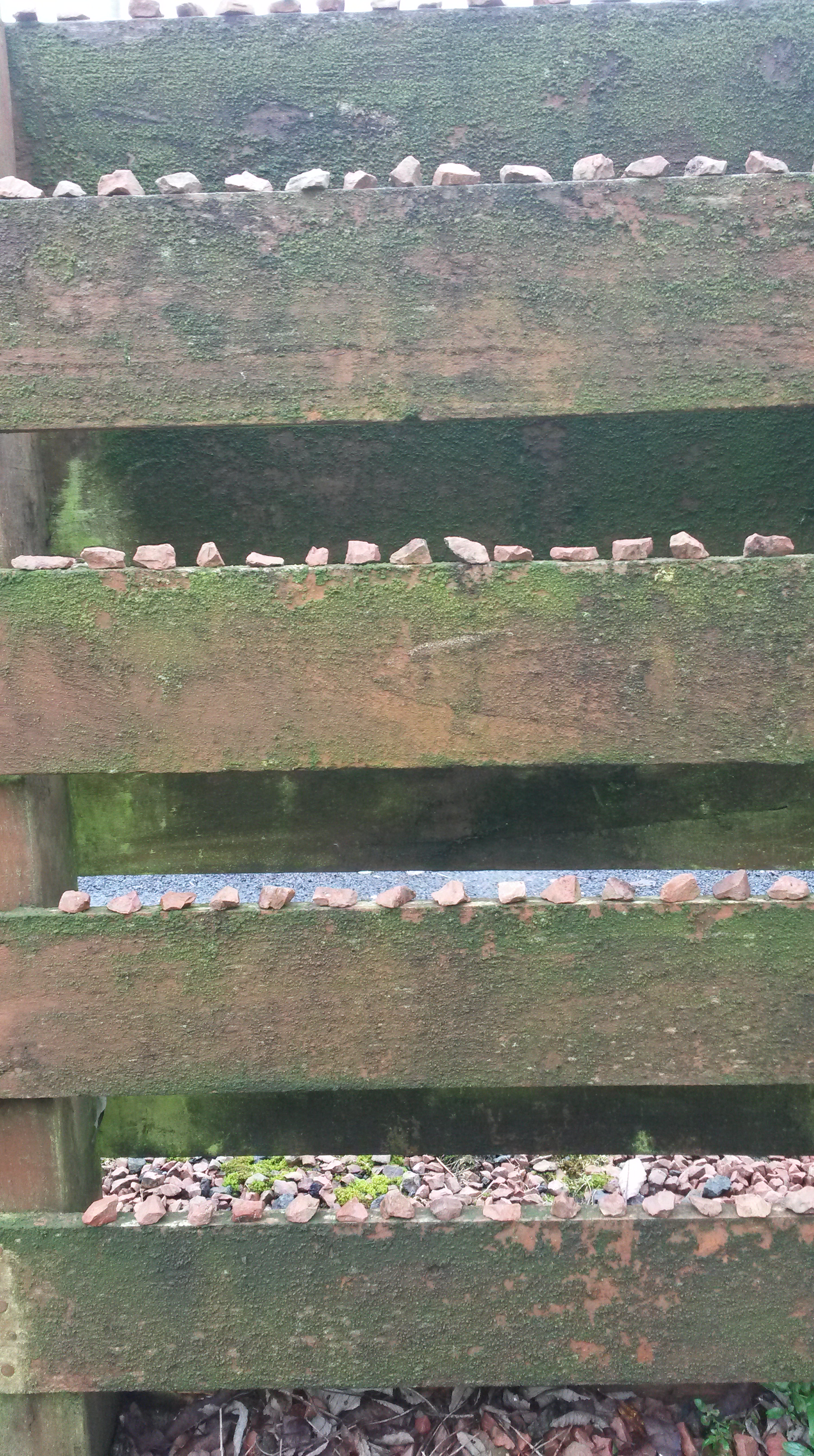
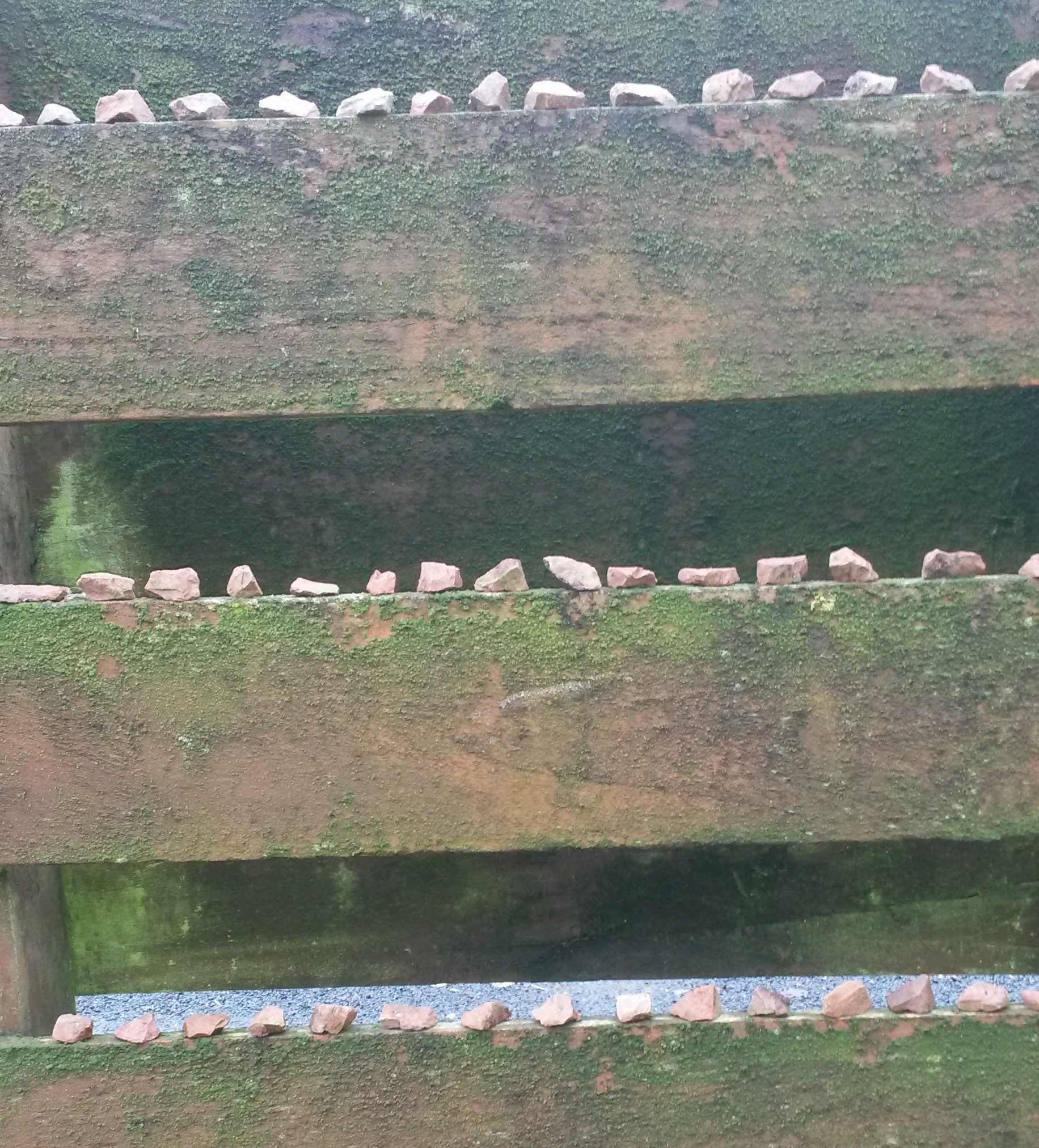
During the first day it hasn’t rained, I decided to take a different approach. I went in to my garden (a place I know well), and spent time just looking. I was looking for inspiration, and also looking for materials to make a drawing from. It is a small garden, so there weren’t limitless things to choose from. I started by taking a handful of small stones and began to place them on to the edge of the wooden fence. This made me think about repetition and order, such as the work of Pierrette Bloch. I put sixteen stones on each of the four rows.
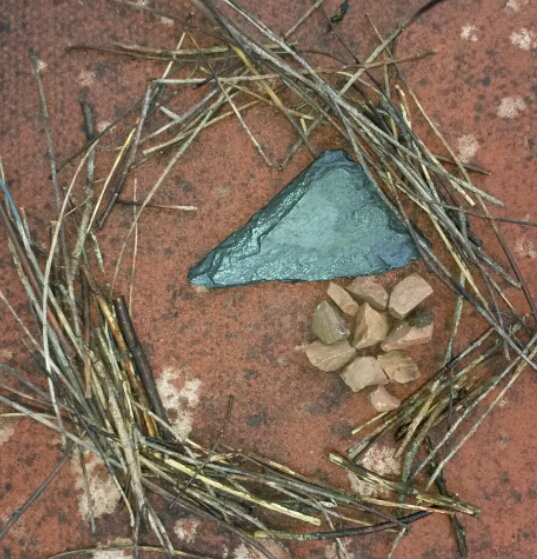
Next I looked around for some other materials to use. I found some twigs from my Willow tree and a piece of slate, that had presumably fallen off the roof. I had a kind of nest in mind, such as a bird would make from the twigs. To this I added the slate and some more stones. I positioned it on a red coloured step.
I felt it lacked something, so I looked around the garden and found some brightly coloured leaves.

I felt this was more successful than my first attempt.
Part Two
Following some discussion with my tutor, I decided to start again with this exercise, this time thinking about the content of my Parallel Project. ‘The place I knew well’ was the Jobcentre.
Again, I have difficulties with issues of confidentiality and Data Protection, so as a starting point I was thinking about hypothetical interventions I could make at my work place.
- Make use of found objects, for example; pens, unused forms, used forms, mugs, cups, jackets, prints left at the printer, calendars, printer paper, sweets, keyboards, mouses, leaflets, cardigans, chairs, couches, tables, photographs, claimant’s ‘units’ (see below).
- Files are called ‘units’ and aren’t filed alphabetically, as you would normally expect, but by signing cycle, day and time. These could be ‘re-organised’, by filing alphabetically, or by alternating colour, or randomly, which would could major disruption to staff, customers and probably result in disciplinary action for me if found out! Chaos would ensue, but I don’t feel it would be right to inconvenience customers in this way, potentially causing delay in payment of their benefit.
- There are three fridges in the tea room, where food regularly goes missing. What if I swapped the food into different fridges? No real harm done just inconvenience and a wee bit of chaos and disruption. Or put other people’s names on the food in the fridge, see how much of it I could eat myself, without being caught?
- Unplug cables from the back of the computer terminals.
- Park in someone’s car park space, or block the car park totally.
- Stick an out-of-order sign on the lift door and see how long it takes to work out it’s a hoax.
- Ask staff a question, ‘what does your job mean to you?’, ‘what is the Jobcentre?’, describe the Jobcentre in 3 words.
- Make images, such as those made I in the garden, but use found objects at work.
- Speak only in French. Repeat everything anyone says, like you did as a child.
- ‘Prank’ some people, put someone’s stapler in jelly (like the prank in The Office).
- Swap letter keys on someone’s key board and do the wee IT trick, where you cause the image on the display to appear upside down.
I tried using the photo copier as a media and photocopied things I found randomly on the desks nearby. I included myself, ‘using things found around you and your own body’, by photocopying my hand. I liked the resulting images. Because the items weren’t flat and the lid of the photo copier was raised allowing light to get in, it made the images very dark and interesting.
The copies were all made at the one time. I worked very quickly, so as not to be seen making the images, in order to avoid having to give an explanation. Because I was working quickly I was ‘thinking on my feet’, impulsively trying out different things.

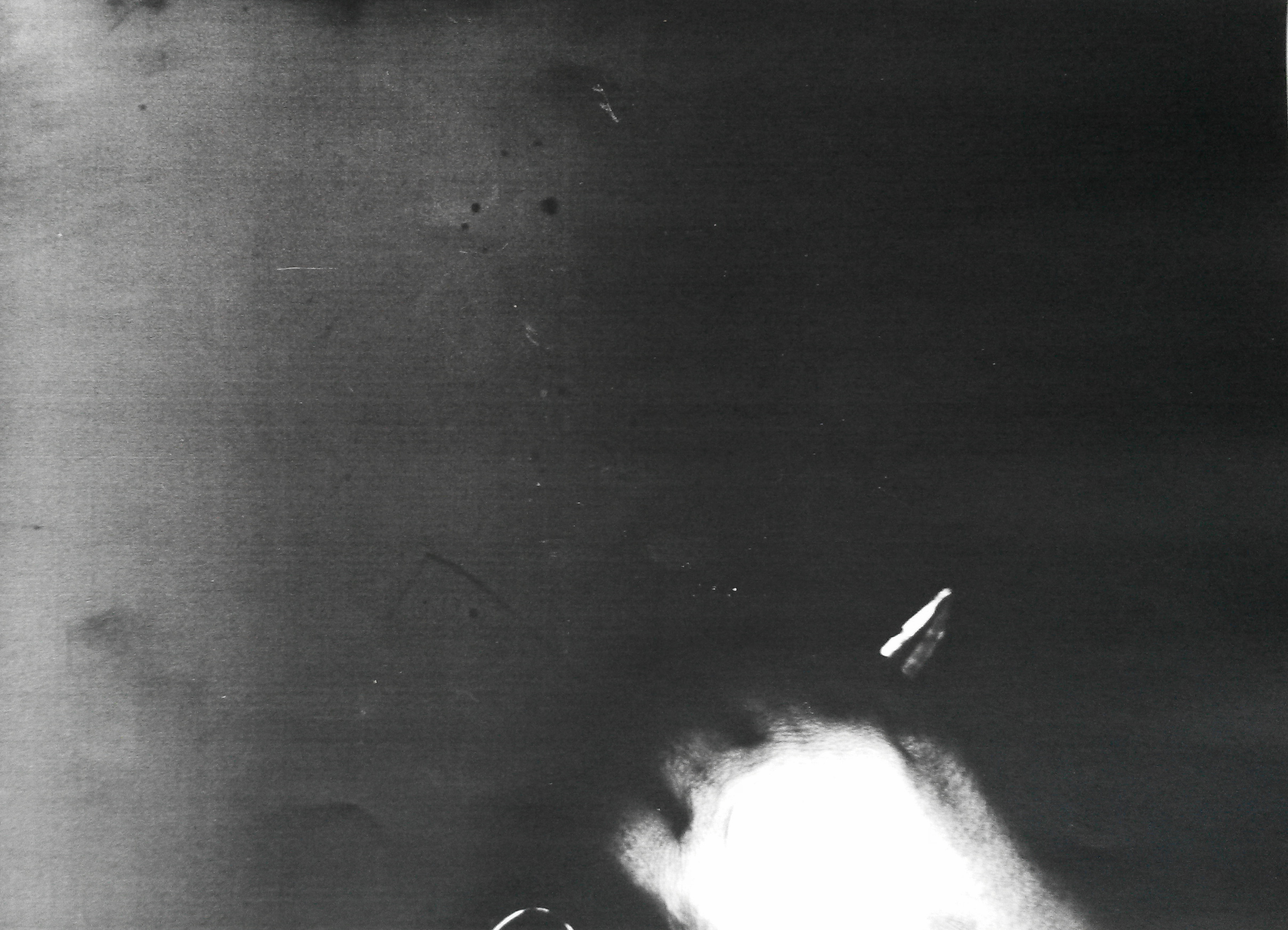
- The first image I made was of my hand. I placed the palm of my hand flat on the glass plate, thinking that the image would be of the top, like a photograph, but of course it was of the surface on the glass, i. e. the palm of my hand. I like the image because it is cropped at the side going off the edge of the paper. I like that there is a lot of negative space to the right of the hand and I like the scores and pen marks left when people have been photocopying with a pen still in their hand. I like the tonal contrasts, the shadows in the creases on my skin and the shine from my rings.
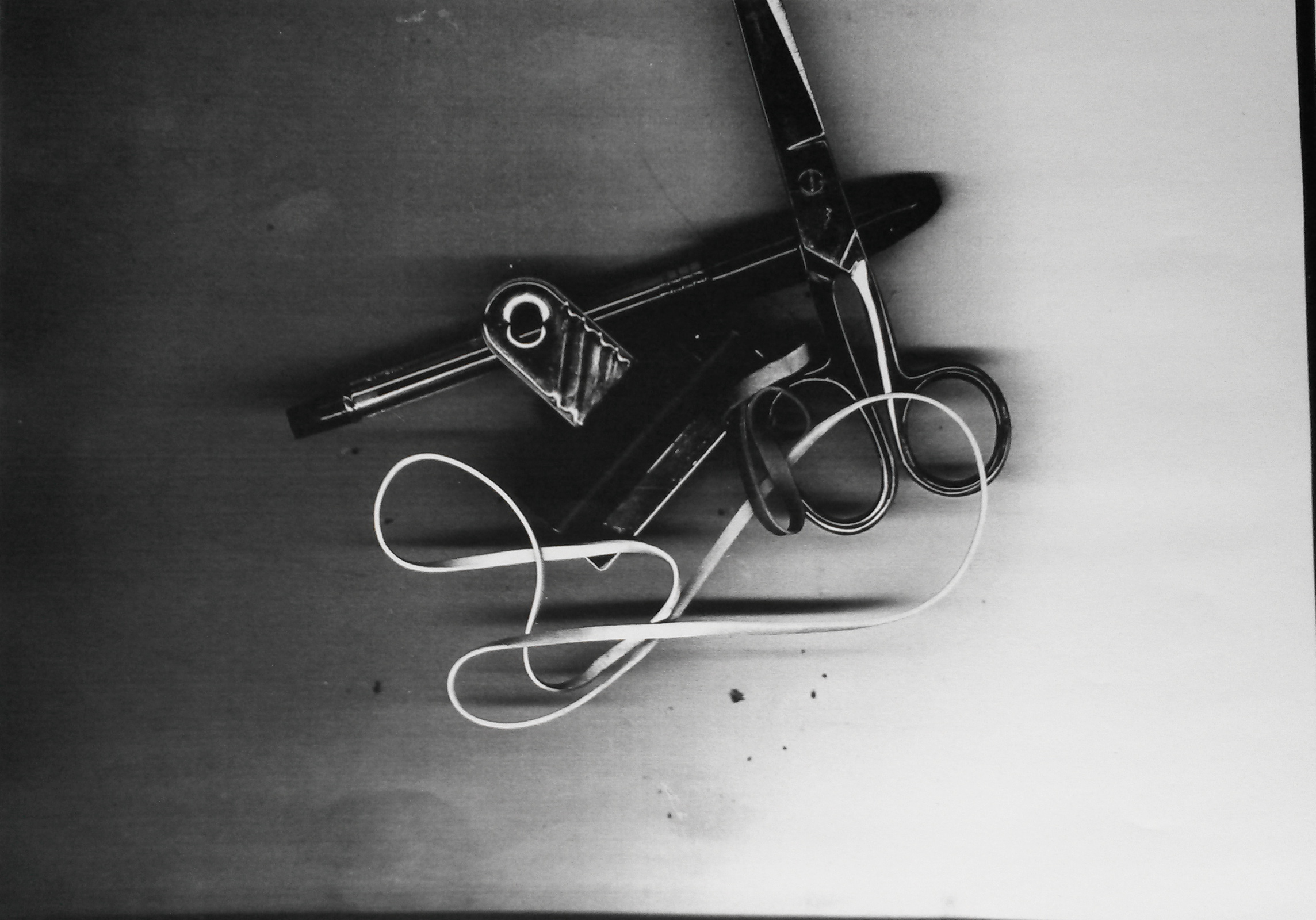
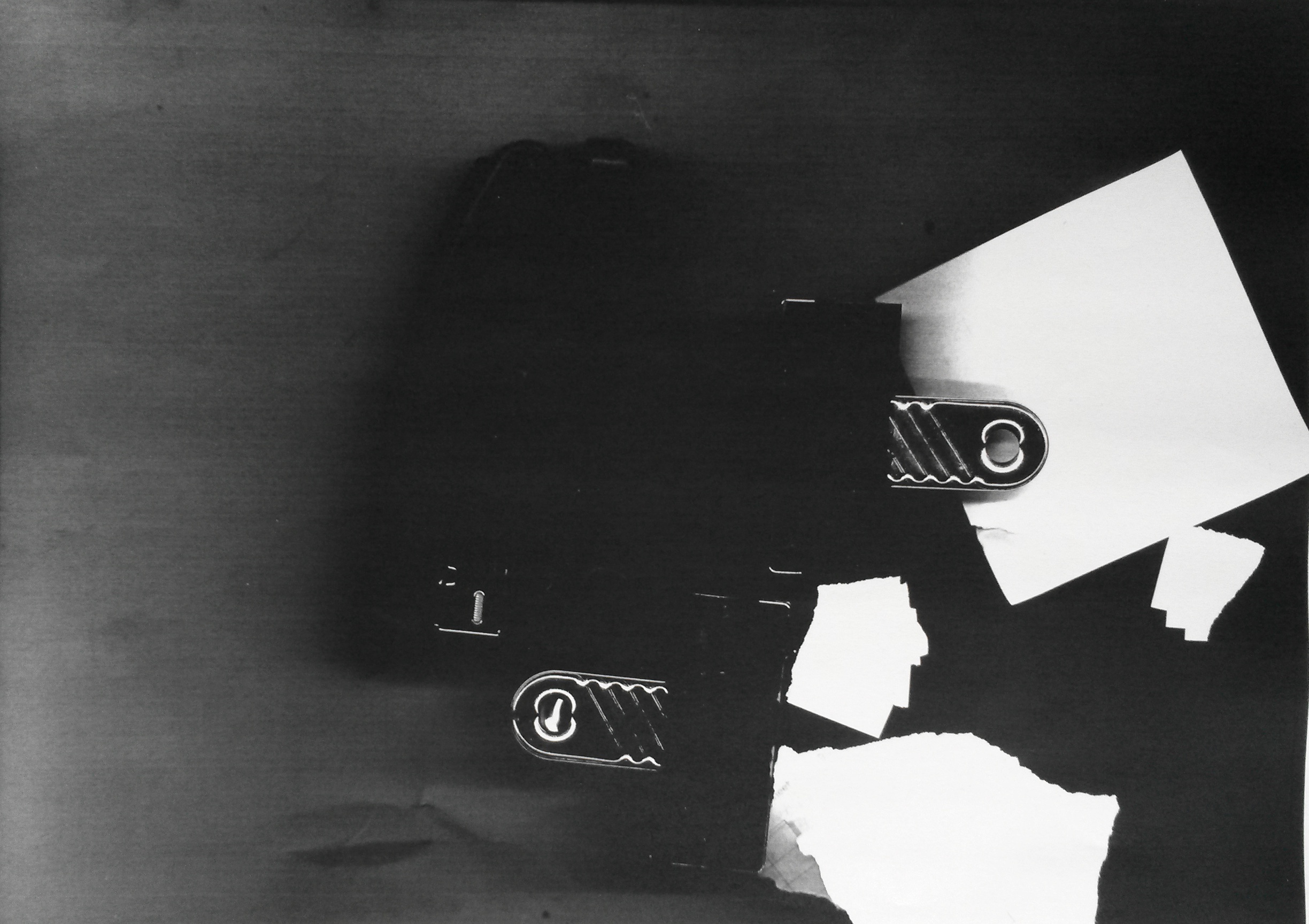
2. I then started looking around at the empty desks nearby and grabbed some random items; scissors, some rubber bands, a pen, and a bull-dog clip. I didn’t arrange the objects, but just plonked them down and copied them the way they were. Again, I like the dark and light contrasts and the shapes the objects make. The loops of the elastic bands mirror the ovals of the scissor handles, and the circular screw on the scissors mirrors the hole in the bull-dog clip. The straight lines of the pen, scissors, bull-dog clip and even the elastic band mirror each other. The cropped scissors lead your eye up out of the picture. It is a wonderful composition of random objects arranged randomly.
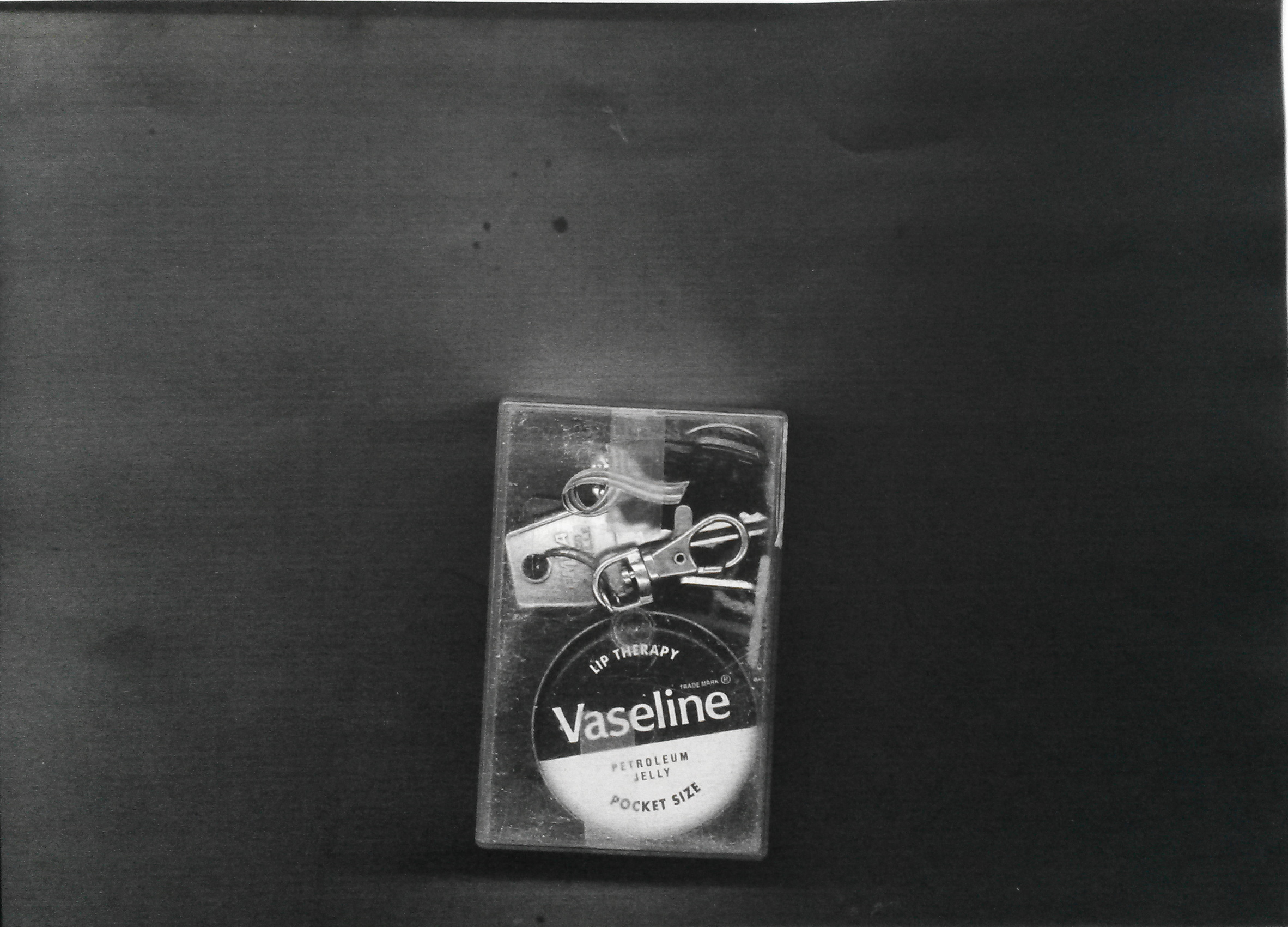
5. The last image is of my hand gripping scissors. My knuckles are pressed against the glass plate and my hand is cropped because, mistakenly I’ve placed it in the wrong place. I tried again and took a perfect picture of my hand gripping scissors, but discarded this, preferring the imperfection of the image above. It has abstract qualities, and I don’t think you would immediately know what it was without being told. The light has captured the creases in my skin and each end of the scissors. It’s quite a ghostly image and the back ground is black and mysterious. The holding of the scissors could be sinister, it could be a weapon and I find the image to be a little threatening. The cropping could imply movement off, or on to the picture plane.
Reflection
I’m reflecting on Part 2, as I consider the more successful of the two attempts. I’ve deviated quite a bit from the brief, because it was necessary because of the restrictions in place at my work, however I am satisfied with the outcome. I haven’t created a simulacrum, the objects are life-sized and I did not arrange them into a still life composition, but the image was created from the way they arranged themselves on the glass. The images could be arranged under glass, so in that regard, it may not be ‘site specific’. I think that viewers may consider it as art, in a way that they absolutely wouldn’t have with any of the hypothetical interventions listed above.
 My drawing2 blog