Author Archives: annemacleod2013

Unknown's avatar

About annemacleod2013

I am currently studying with OCA on the Painting Degree pathway

Bibliography

The following is a list of books I used for the majority of reference, although I did read many others not included;

The Amazing World of M C Escher. The National Galleries of Scotland.  Edinburgh.  2015

Art Since 1960.  New Edition, Archer, Michael.  Thames & Hudson world of art.  London. 2012

Drawing Now. Between the Lines of Contemporary Art. TRACEY. I B Taurus.  New York.  2007

Drawing Now: Eight Propositions, Hoptman, Laura.  The Museum of Modern Art, New York.  2002

Drawing Projects.  Maslen, Mick and Southern, Jack. Black Dog Publishing. London. 2014

Gombrich, E H (2011) The Story of Art, 16 Edition. London: Phaidon Press Ltd

‘John Bellany, Keith Hartley with Alexander Moffat, John McEwen & Paul Bellany.  National Galleries of Scotland 2012

Modern Art.  Flame Tree Publishing. London 2005

The Poetry of Place, Duncan Shanks sketch books and the Upper Clyde, Freight Books.  2015

The Two Roberts, Robert Colquhoun and Robert MacBryde, Elliott, Patrick.  National Galleries of Scotland.  Edinburgh. 2014

The 20th Century Art Book.  Phaidon 1996


M C Esher exhibition

Last year I went to see The Amazing World of M.C. Escher at the Scottish National Gallery of Modern Art.

About the Exhibition

M.C. Escher is one of the great conundrums of modern art. He is an artist whose work is as instantly recognisable as anything by Salvador Dalí, yet his name means little to a British audience. Escher was never affiliated to any group, rarely travelling far from his modest home in the Dutch town of Baarn, and focusing exclusively on graphic art. He was a one-man art movement who created some of the most famous and popular images in modern art, yet he remains a complete enigma.

This exhibition features over 100 prints and drawings spanning his whole career, and is drawn in its entirety from the Geemeentemuseum in The Hague, in the Netherlands, which holds an almost complete set of Escher’s prints. It is also mounted in collaboration with the Escher in Het Paleis, a museum of Escher’s work which opened in the centre of The Hague in 2002.

I have always liked the work of Escher.  I like the precision and perfection of it and I learned at the exhibition that this was in part because his brother was a Mathematician and helped him work out the exact calculations for the reflections on the spheres etc. In addition his father had very exacting standards and would point out any flaws in his work and suggest he did it again.

I particularly admire his Metamorposis 1 where the negative spaces between fish gradually morph into black swans.

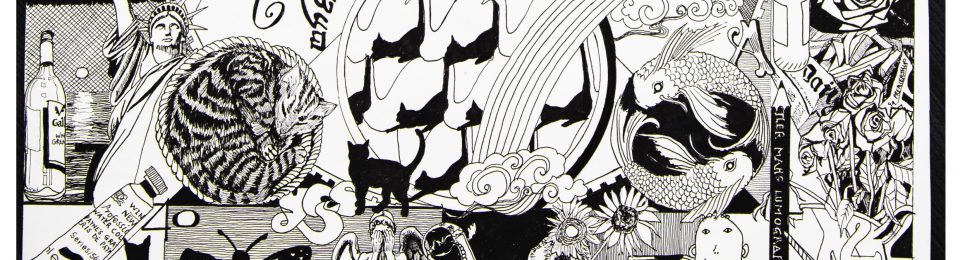
I included his drawing in my Time and the Viewer drawing.

cropped-annemacleoduni1.jpg

Time and the Viewer black drawing pen

cropped-annemacleoduni12.jpg

Time and the Viewer

My homage to Escher; black cats morphing into white swans.

References

https://www.nationalgalleries.org/whatson/on-now-coming-soon/the-amazing-world-of-m-c-escher/about-the-exhibition-23618

Adrian Wiszniewski demonstration

Adrian Wiszniewski was born in Glasgow in 1958 and trained at Glasgow School of Art from 1979 to 1983. He was a leading figure in the revival of figurative painting in a group known as the New Glasgow Boys.

Adrian Wiszniewski RSA, HonFRIAS, HRSW (b.1958) creates work characterised by a strong drawing element and fertile imagination. Populated with contemplative figures set in vividly coloured Arcadian landscapes, his paintings are rich with symbolic, political and philosophical depths.

I have attended a demonstration by Adrian Wisznieski at Paisley Artists before.  This one was particularly memorable to me, precisely because it appeared to have been completely unmemorable to him; he arrived half an hour late and seemed to be completely unprepared.

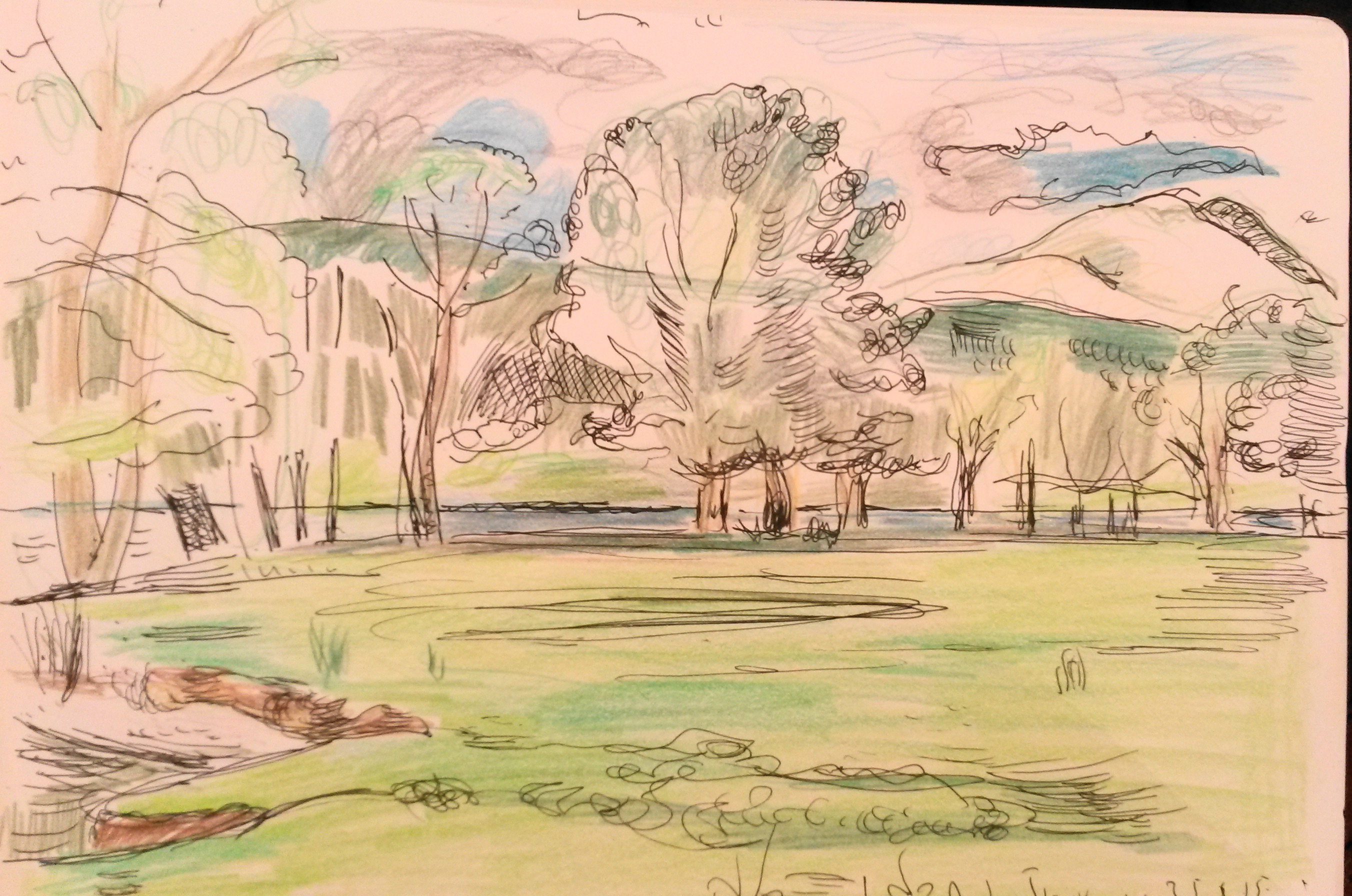
He had brought his sketchbooks with him though, and this was particularly interesting because he told us he was starting to develop an interest in landscape drawing that he had never had before, as a result of securing a Creative Scotland Grant for a trip to New Zealand.

User comments

Adrian Wiszniewski


User comments

Adrian Wiszniewski

User comments

Adrian Wiszniewski


User comments

Adrian Wiszniewski


User comments

Adrian Wiszniewski

User comments

Adrian Wiszniewski

User comments

Adrian Wiszniewski

He said that he was not much of a Painter, he preferred to draw.  When he starts to draw, he has no intention of how the drawing will look.  He will start out with a large sheet of paper, often taped to a wall.  He will begin in the middle of the paper by drawing an eye, for example, then will start to fill the sheet.  He makes marks, like a piece of music, adds different layers, has repetition, and won’t know what it’s going to be about until the last stroke.  He was influenced by Van Gogh, his work is full of energy.  He trusts his subconscious mind; it’s almost like an archaeological dig, drawing to uncover what the picture is about.

He always has a sketchbook with him, but seldom works from what is in front of him, preferring to work from his imagination.  He showed us some drawings he made recently on a train journey.

User comments

Adrian Wiszniewski

User comments

Adrian Wiszniewski

User comments

Adrian Wiszniewski

Here he is drawing at the demonstration;

User comments

Adrian Wiszniewski

And here is the drawing;

User comments

Adrian Wiszniewski

I found him to be fascinating to listen to.  He has eclectic interests and seemed to jump from one subject to another.  He said the trick was to stay interested in what you are doing, if he stops being interested he will move on to different media and has used Perspex, stained glass and fluorescent light.  I liked that his work was under pinned by drawing, and he wasn’t interested in ‘art speak’, as he called it, as he thought an artists should at least be able to draw.


http://www.openeyegallery.co.uk/artists/adrian-wiszniewski/?p=artist-details/adrian-wiszniewski/


Research on Stephen Walter Part 5

Reflection: Stephen Walter is a contemporary artist who works a lot with drawing and mapping.  He works I such detail that the viewer needs to use a magnifying glass to experience parts of his art work.  Look at Walter’s work, read his comments and reflect on them in your log.  What does such a fine level of detail lend to the image?

Stephen Walter’s biography on his website states ‘Stephen Walter’s work is an investigation into obsessive drawing techniques, semiotics, the glory of maps, and where Landscape is seen a receptacle for meaning. Each work is an intricate world in itself. The maps are a tangle of words, symbols and drawn elements where cultural residues inhabit certain locations‘.

When I first looked at the level of detail in Walter’s drawings, particularly in his maps,

I was a bit over whelmed and thought ‘do I really want to read all that?’ Curiosity drew me in and the whole thing really grabbed my attention.  It is packed full of information, often amusing, such as a place called ‘Eyesore’ in Nova Utopia, 2013.  The scale is sometimes large, particularly the maps, for example the print Nova Utopia, 2013 is 133.5 x 171.5 cm.  The large size of the map contrasts with the tiny intricate pieces of information it contains.  The viewer has to get up close to the print to absorb all the information and it is worth the effort as they view Paranoia HQ and Middle age water colourists. I found it to be very funny and clever and wanted to read everything, and despite the size, I really enjoyed it.

Reference

http://stephenwalter.co.uk/

Pre -assessment review of Drawing 2

Overall Evaluation

Now that I have come to the end of Drawing 2, when I look at the final pieces I’ve made, I barely recognise my own work.  I decided from the outset that I would push myself during this course.  Being my first level 2 course, I knew it would be very different from what I’d experienced before.  Prior to studying with OCA, I had very little experience of contemporary art, particularly Installation.   When I was researching Cornelia Parker’s Poison and Antidote drawing, I thought at first, it made no difference what medium she used to draw with; it was the visual image at the end that was important.  Now I am at the end of the course and my opinion is the complete opposite, hence the subject matter of my Critical Review; the Artist as a Recorder.

It wasn’t an over night change for me; it has been more gradual.  The research in the course work prompted me to look at artists I would never have known about, like Martin Werner, Janice Kerbel and Steven Campbell.  It taught me there is an infinite number of ways to make art.

The projects pushed me into trying some of these ways for myself.  Some were familiar, such as the observational drawing in Part 1, mark making and composition, but many I found very difficult to do, such as the drawing with a machine, using found images, interacting with the environment and my nemesis; installation. In addition, I had to relearn academic writing and referencing.

I think looking at the Parallel Project highlights the process I went through from the start of the course to the end.  I began by making observational drawings, initially portraits of the staff, then graduated to drawing the office environment.  Using my new way of looking at every day things, my attention was drawn to the grey dots on the privacy panels, and I thought about repetition and pattern, and the way in which they are used to protect someone’s privacy, and this eventually lead to me finding a way portray the experiences of the people.  By developing a new way of seeing and recording, added to the encouragement from my tutor, I was brave enough to attempt to express these experiences in an authentic way.  It was very daunting showing other people this work, and I was so out of my comfort zone, but I believe it has paid off.

I think the turning point for me came at Part 4, when completing the project on interacting with the environment.  I read the instructions and literally made images using material from the environment, such as leaves and twigs etc.  I had stalled at this point, lacking confidence in my choices, and eventually decided I would just need to do something, rather than hesitate any longer.  I contacted my tutor Bryan, and showed him the images, expressing my disappointment in the outcome.  I told him about the groundwork I was doing for the parallel project, and how capturing my experiences at work had caught my interest.  He suggested focussing on this area and I decided to outline some hypothetical interactions I could make at work.  I enjoyed doing this; it caught my imagination, I had fun with it and added humour.  I also enjoyed the new experience of making art by writing.  This made me realise for myself, how you make art, what you use, what you do with it, what you want the outcome to be, these are all up to the artist to decide.  There is no definitive guide and there is no one out there to tell you want to do, it’s all up to you.

With this experimentation has come understanding; it helps to to understand the process and the concept, and looking at and researching other artists help you do this.

Although apprehensive, eventually I realised that the only way to learn is to embrace the challenges. If you do what you’ve always done, you get what you’ve always got.

In addition, the OCA Study visit to the Turner Prize I participated in, couldn’t have come at a more fortuitous time. Whilst I may not personally have appreciated seeing fur jackets sewn on to tubular chairs, because of the research I had already undertaken, I was able to understand Nicole Werner’s concept.  This again, reinstated my new-found discovery that art can be; a choir singing, an environmental project, a library, or indeed fur jackets from Ebay stitched onto chairs.

Looking back, I found Drawing 2 to be a very difficult course to complete, but definitely worthwhile.  In addition, I feel I have been very fortunate in having Bryan Eccleshall as my tutor.  He was most encouraging, and gave me the confidence to try new things, and his own work as a practicing artist was inspirational.

My local art group enjoyed watching me drawing the Time and the Viewer piece so much, we gave it a name Autobiographic, and three other members have since made their own.

It has helped me to develop a new way of looking at every day things.  I can look at something objectively, see it as a shape, a series of lines or composition, I’m curious when I see areas of grass or carpet worn by constant tread of people. Or marks left by repeated activity, or ephemera left lying around in a particular way.  I would never previously have noticed these things, or associated them with making or appreciating art.

The course also helped me develop problem solving skills, in so much that it forced me to think about alternative ways to make marks.  For example the Collography process I used on the Parallel project artists book, my experimentation with the use of Letraset to add text to a drawing, the use of bubble wrap to censor the personal details.  And who could forget the drawing with an electric tooth brush!

More than ever, the artists books I made were a huge step forward for me.  It was most enjoyable pointing out the idiocy of some of the rules at work.  I found the parody of the rules and regulations cathartic.  I enjoyed the writing part very much, and again, would never have contemplated this as ‘making art.’

This has given me a confidence I hope will stay with me as I continue on my Painting Degree Pathway


Collaborative Drawing Project

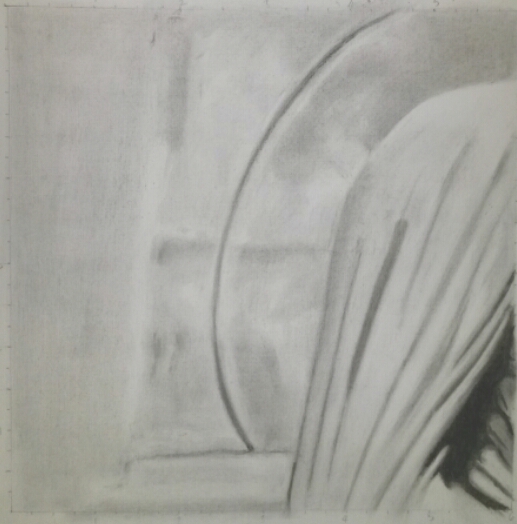
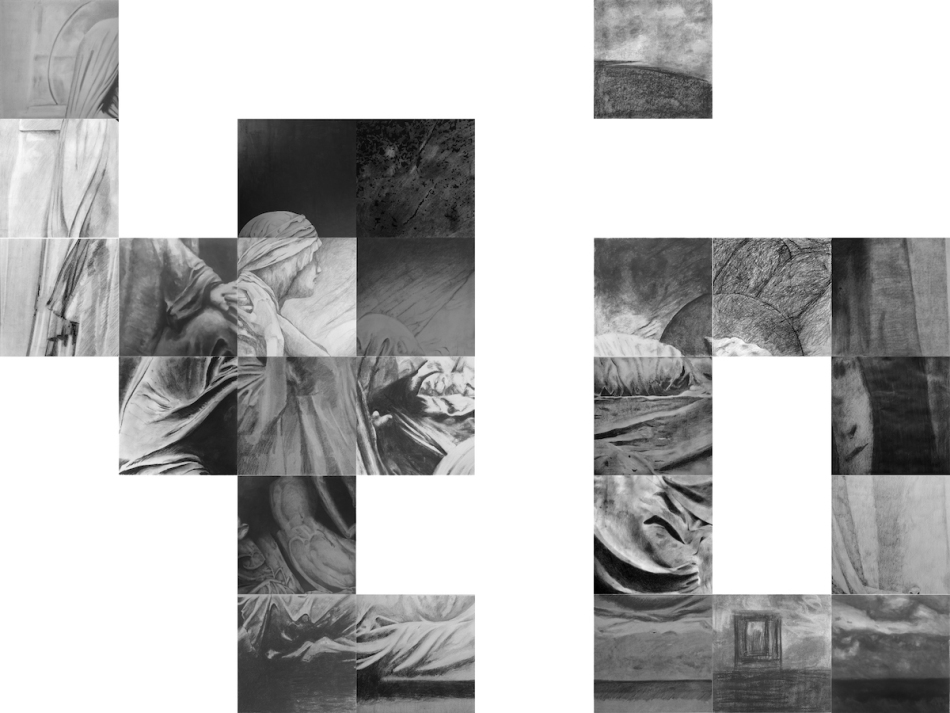
I participated in a Collaborative Drawing Project organised by my tutor Bryan Eccleshall.  The instructions were that each person would have two panels to draw.  Each drawing was to be 12 inches x 12 inches, and had to be monochrome, but could be in any appropriate medium. It was to be made using the grid method, so that the proportions would be fairly accurate.  This is one of my panels;

2015-11-24 18.27.08

12 ” x 12″ charcoal

And here is how it fitted in to the overall drawing.

collaborative-drawing2

I wasn’t asked to send the actual drawing, just a photograph.  Bryan said that if the actual drawings wee to be assembled the whole piece would be eight feet by six feet.

I found the project exciting to participate in.  It made me think about Bryan’s role as the artist.  He didn’t complete any of the panels, however he was still the creator.  In a way, the participants became his media and he dictated what we created for him.

My response to Tutor Report on Assignment 6

I don’t have much to say because the report was written as the result of a Skype tutorial, therefore it was more of a discussion and I took my own notes.

I was relieved at Bryan’s positive response to the work I submitted for Assignment 6.  As I said at the time, I wasn’t convinced at it’s success, and was very much outside my comfort zone, but Bryan has reassured me that my reaction is a good one, as it shows I am pushing myself and not just staying with what is comfortable.  I appreciate his feedback and will crack on with getting my submission ready for the November Assessment.

Tutor Report on Assignment 6

Student name Anne McLeod

Student number 497519

Drawing 2 Assignment number 6
Type of tutorial (eg video/audio/
written) Skype

Formative feedback
Overall Comments
This is your last Drawing Two report. Congratulations on completing the course. It’s not easy and you’ve applied yourself well to a challenging set of circumstances. I believe that you know think of art in a different way and – as you have said – are more open to accepting different approaches in how art works are made. Well done.
This report acts as a summary of your experience of the course. You have supplied notes based on our video conversation. An edited version of these notes are here are in black and have been supplemented in red. The report bis plot into the Parallel Project, Critical Review (and you also have my notes on that document), some notes on submission and a summary. I haven’t included all your notes as we repeated our selves a bit. However your notes are good and all are relevant.
Parallel Project
Demonstration of technical and Visual Skills, Quality of Outcome, Demonstration of Creativity
Bryan […] asked how I felt the step up from D1 to D2 had gone. I’m still out with my comfort zone, but felt I made a bit of progress towards the end. Discussed processes, taking photos first then sketchbook work. Bryan said he thought it really worked, he liked the text that I’d written, work that I’d done; the way it starts off very technical then becomes satirical. It has a measure of control, as a piece of writing it sets the stage for the rest. There is an interesting density to the drawings and the monochrome works. The first piece with the drawing of the people in the cubicles is actually a really nice piece of drawing. You have incorporated hand drawn elements. I explained the collograph print process I’d used to avoid the drawing becoming too tight. Bryan liked that I’d thought about the process. He liked the face. He liked it all. The dots give it a texture and continuity running through it, it unifies it. He really liked the ‘abstracty’ one with the tight crosshatching and the repeated text, it just seems like a really strong page design. It reminded him of Philip Guston.

This was based entirely on the look of one page, but it’s good to follow up visual similarities. Huston also made work that accompanied poems, showing how images can work with text without being illustrations. He thought I’d made a really interesting document, he liked that I’d challenged myself, he liked that I’m still not sure, I’ve persisted with it but still not sure, that shows it has a power to change me. I may decide never to try this type of work again, but ‘I’ve kicked open some doors). I agreed that I have started to look at things differently. Bryan said that no matter what happens next, the course has worked, artists notice stuff that other people don’t notice, and make connections that other people don’t see, and make work out of it. I’m connecting the patterns in the office with the people I meet and the difficult protocols I need to work with. I’ve shown humanity, respect and honour the people I meet, not pity, but appreciating there is a difficulty and monotony and recognise that these people are stuck, but I’m also saying ‘I’m stuck here too, I’m stuck in the same bureaucratic system you are, a common cause, prisoner/jailer scenario – a system. Bryan asked if I had shown colleagues, which I haven’t, I said because I don’t think they would have understood what I was trying to do, I wouldn’t have understood it a couple of years ago, Bryan thought that was interesting and it shows I’m learning.
Using ‘authentic’ documents, or logos from work, grounds it in truth, the closer I get to making my book look like the documents I work with; the more effective it will be. I said I was going to put it on the noticeboard at work and take photographs of it. Bryan liked this – it’s anarchic. Assessors would like to see this, it’s following through as much as you can. Bryan recommended when submitting for assessment, I put it in an A4 envelope, marked for assessor’s eyes only, this cannot be reproduced, it can’t be circulated, I could use a grid envelope as this pushes it a little bit further, but make the situation absolutely clear. […] Bryan thinks it is a really strong piece of work, I’ve used drawing, alluded to painting; it is reminiscent of the work of Sigmar Polke, who used a lot of layering and pattern, and screens. He likes the post it notes, it has something quite interesting going on, I’ve come up with something challenging, it has roots in observation. It’s evident that you are now ‘getting’ the work as a process of looking and connecting more clearly than when you started. That’s a huge shift in your understanding of how art is made and where it comes from. It also accounts for how art looks. Your ‘book’ is neither a description or a representation of something and any narrative it has is complicated. This is a huge step from the requirements of Drawing One and shows how far you’ve travelled. Well done.

Critical Review  See also notes on the script.
The Artist as a Recorder: Bryan thought I’d struck on something. My observations on use of ‘authentic’ material and ephemera….if I want more space I could edit Erased de Kooning out, look at including Blake in the conclusion. Interested in my use of the word ‘authentic’, he knows that I mean material that is particularly pertinent to the subject, the material is actually the subject, for example Cornelia Parker’s Venom and Antidote, the material is as relevant as the drawing. I need to explain my use of the word ‘authentic’, I could put a foot note in, not the definition from the dictionary, but my meaning, and then when I use it throughout the essay, use quotes to show it’s my use of the word, and to explain that I don’t think that where ‘authentic’ material isn’t used, that it is fake. It is important to highlight this as I’m making an important observation. This relates the final piece for the Parallel Project.
He likes that I’ve looked at other artists differently, for example Peter Blake, I see him as recording something, Hamilton’s collage, I’ve made him think differently about it, looking back at it now in 2016, it was a vision of the future, we see it now as cute and retro, but it’s still futuristic, it does this collapsing of time, he is looking at it differently now, I’ve shown him lots of things – ‘I like it when students teach me things’. True. You have uncovered a way of looking at artists that is particular to you and even though you are likely to remove some from the Critical Review, that doesn’t mean they stop being relevant. Through your writing you have found a ‘lens’ through which to look at artists and their work which feeds into your practice.
Submission Advice

I need a paper and digital copy (email word document) of the Critical Review, check on line for current assessment rules. Numbers are guidelines, you can be over, discernment is important. Look at Criteria. My book shows creativity, I’m setting myself difficult things to do. My work shows technical and visual skills, e.g. paperclip drawing, relevant to office environment. Quality of outcome can be demonstrated in my blog where I post lots of stuff. Discernment is knowing what your best work is, knowing the best elements in the work to expand on, – I’ve stuck at something that’s difficult, I made work in an environment that is hostile, which forced to work and respond in a certain way, I’ve responded in a way that’s surprised myself – be very explicit in my learning log about how far I think I’ve travelled – when I started I thought I would be doing this …, look at what I’ve done now, I now understand …, make it absolutely crystal clear in a final statement on the course, as it’s a nice thing for assessors to read, they can’t read everything but they read the last post at the end to see what you think you’ve learned.
I asked about the Mind Map and Contextual Statement. This could be a reflection on my course, ‘reflection on the course’, where I started, ‘ As I now prepare my portfolio, I look back and realise how different the work is from the beginning at the end, say why you think that is, what you’ve become interested in…a lot of students would be afraid of making a piece like this because they think it will stop them from being able to draw in a conventional way, but it doesn’t and suddenly you can bring in that drawing skill into a new frame. It needn’t be a long statement, just something readable, unpretentious and straight forward, and if there is a moment when it clicked into place, for example the Alistair Gray portrait, I connected with it, suddenly it wasn’t just a portrait, it helped me connect with the subject of the painting or something in myself. You can start the statement with this moment, it doesn’t need to be chronological….I saw this painting and it really clarified things for me…because when I started I thought I was going to be doing…I had to do a lot of work and then narrow it down and focus on one thing and that helped produce some really solid stuff.
A mind map is useful to show how interconnected everything is, how to artists relate and how do paintings relate, but it isn’t essential to do one.
There isn’t much to add to what you’ve noted down here, except to reiterate that being very clear is important. Don’t write in a pretentious or ‘arty’ way. Write about what has happened to you and your work and explain how that change has come about.

Summary
● Well done on completing the course and with engaging so completely with it.
● The Parallel Project shows me that you can think in an interesting way and be bold in how you make work, even if this is a one-off piece. It seems like a ‘site-specific’ work in that it responds directly to the restrictions under which it was made.
● The Critical Review feels like the beginning of a practice. You have, I think laid the
foundation for a way of thinking about the production of art and your place in that
process.
If you need to run anything by me before submission, please don’t hesitate to get in touch.

Bryan Eccleshall
Date 4th September 2016


My response to Tutor Report 5

A Changing Scene

I agree I could have achieved a better outcome in this exercise.  I feel that time is against me as the assessment approaches,  so don’t think I will be able to go back to a busy shopping centre and sketch the figures, this time tracing the path they follow and perhaps trying a chalk drawing showing the movement and direction.

An Artists Book

I spent so much time researching Artists Books as it’s not a medium I’m familiar with, that I didn’t give my take on it. I will do a second draft of this.

I’m curious about Bryan’s reference to Cy Twombly’ interest in the scribbles and subconscious mark-making, so I will definitely explore this.  In addition, I think I realised myself that I should develop the idea of doodling whilst listening, and what these drawings could mean.  Overall, Bryan’s comments are positive and encouraging so there’s nothing else for it, I need to push on through my discomfort and try to experiment more and try to have some fun with it. I like Bryan’s phrase ; Making copies of the pages and working into them again (and again, and again) might also reinforce the repetitive nature of bureaucratic systems.

Bryan’s collage work is interesting and I’ll look into this further.

A Finer Focus

Again I have positive feedback here, but need to think more about how it felt to make the work and perhaps link it to my Parallel Project.

My research on Stephen Walter’s drawings needs more work.

Time and the Viewer

I am pleased at Bryan’s positive feedback, but unsure about his suggestion of adding text.  I could play about with it a little on photo shop etc before committing to any changes, as I do like it the way it is.  I like the key reference as per Peter Blake’s Sergeant Pepper and will definitely do this.  I’m really interested in Bryan’s reference to the YES logo.  This interests me a lot.  I’ve read about other artists inspiration from music, or poetry etc, but never been sure how to use it.  I definitely think my love of YES’ music is relevant.  It is unfashionable, uplifting, technically brilliant, poetic and random, all at the same time. There is a place for it in my work some where.

Bryan says ; Often our work can be informed by other cultural interests? How might different artists approach cooking, for instance? Andy Warhol: a ready meal? David Hockney: something tasty and fresh, but improved from ingredients? Whereas a conceptual artist might follow a recipe meticulously.

I also like the comment; ‘In a sense, this could be viewed as the artist having power over the viewer and the ability to ‘steal’ their time’ – is interesting. Does the art work also steal time from the artists, demanding to be made in certain way.  This is definitely true, much to the frustration I felt making A Finer Focus and Time and the Viewer.  I will include some dialogue about this in my blog.

I’m interested in the suggestion of a Mind Map covering all the work I’ve made for Drawing 2, although I think it would be huge and quite detailed but it is worth pursuing.  I need to research the Contextualising Statement more before attempting this.

Pointers for the Next Assignment

Reflect on this feedback and link it to my last report

Think back over the course and eke out links between things

How does the statement ‘As an artist you are responsible for not only making your  work but also recording its making, especially in THIS context’ fit with the ‘Artist as a Recorder’?